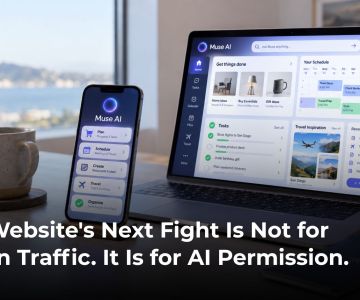
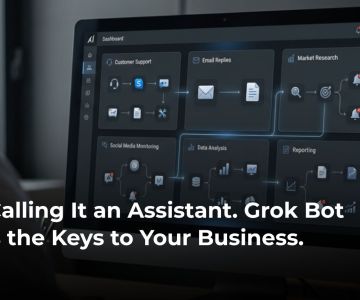
Meta’s new business AI pitch is easy to like.
Stop exporting reports. Stop rebuilding spreadsheets. Stop guessing what to post. Let the AI look at your Facebook, Instagram and advertising results, find the patterns and tell you what deserves attention.
That is genuinely useful.
It is also exactly why small businesses need to stop treating AI permissions like harmless setup screens.
Meta AI gets better when it sees more. More campaign data. More content history. More documents. More email context. More of the information that explains how the business actually works.
That is the product advantage.
It is also the risk.
The mistake is not using the technology. The mistake is assuming that because a connection is easy to activate, it is automatically sensible to activate it.
The real product is context
There is nothing revolutionary about an AI writing a social post.
Every serious AI platform can do that now.
Meta’s more interesting move is giving its assistant direct context from professional Facebook and Instagram accounts, Meta Ads and selected Google Workspace services.
Meta says the system can analyze reach, saves, shares, comments and profile visits. It can look at advertising performance, identify audience patterns and surface creative that may be weakening. It can prepare documents, spreadsheets and presentations. It can also handle recurring tasks.
That changes the game because the owner does not have to explain the business from scratch every time.
A generic chatbot can tell a restaurant to post behind-the-scenes videos.
Meta AI can potentially tell the restaurant that its own behind-the-scenes videos generated twice the profile activity of its product shots last month.
One answer is generic advice.
The other is based on evidence.
That difference is the entire reason connected AI will win over ordinary prompt-and-response tools for many business workflows.
Stop pretending platform metrics are the business
There is a catch.
Meta knows Meta performance. It does not automatically know whether your company made money.
A campaign can crush its engagement target and still be commercially useless.
Cheap clicks can come from the wrong audience. A popular reel can build attention without producing a single qualified inquiry. A promotion can drive volume while destroying margin. A campaign can look great in Ads Manager and disappoint in the bank account.
If a business lets the platform define success using only the metrics the platform sees, it is already giving away too much strategic control.
This is where owners need to be sharper than the software.
Before asking the AI what to do next, decide what matters outside the platform.
Revenue. Qualified leads. Appointments. Repeat purchases. Margin. Customer quality. Geographic fit.
If those outcomes are not part of the measurement system, the AI may become extremely efficient at maximizing things that look good on a dashboard.
That is not strategy.
Reporting automation is the obvious win
There is one area where the case is much cleaner: reporting.
Nobody builds a competitive advantage by copying numbers into a spreadsheet every Friday afternoon.
Meta says the assistant can create reports, presentations and spreadsheets and can perform recurring tasks. If it can accurately assemble a weekly summary from information the business already uses, that is exactly the kind of work worth automating.
Let the AI gather the data.
Let it flag changes.
Let it organize the questions.
Then make a human decide what those changes mean.
This is how small businesses should think about automation. Remove low-value handling before you remove high-value judgment.
The owner who saves two hours on report assembly and spends those two hours fixing the offer, calling customers or improving the sales process has gained something real.
The owner who saves two hours and lets the platform decide where the next dollar goes without checking the economics has simply traded one problem for another.
The Workspace connection is where casual thinking gets dangerous
Meta says the business features can connect with Google Workspace services including Gmail, Docs, Sheets and Slides.
That is powerful because marketing context often lives there.
It is also where the lazy version of AI adoption falls apart.
Look inside a typical small-business Workspace.
You may find customer emails, employment records, contracts, quotes, invoices, supplier pricing, legal correspondence, passwords reset links, strategic plans and private meeting notes.
Now ask a basic question.
Does the AI need all of that to tell you which Instagram post performed best?
Of course not.
So why would you connect everything by default?
The right rule is painfully simple: give the system the minimum access required for the job.
If you need campaign plans, create a campaign folder. If you need a marketing inbox, use one. If you need a performance spreadsheet, expose that file, not the company’s entire digital filing cabinet.
Convenience is not a substitute for permission discipline.
“Meta AI” is not one privacy policy
Another bad assumption is that every Meta AI product has the same rules.
Meta introduced Muse on September 8, a separate personal AI agent designed to work across applications. Meta says Muse includes controls for choosing connected apps, adjusting access, disconnecting services and opting out of using Muse interactions to train Meta’s AI models. Meta also says Muse conversations and information in its secure virtual machine are not shared with advertising systems.
Good.
But those statements are about Muse.
They do not magically rewrite the terms of every other Meta AI connection.
That is why businesses need to read the product-specific terms instead of relying on slogans, memory or assumptions.
Meta’s broader generative AI guidance says information shared through AI interactions may be used to improve products and for other purposes. Reporting around the August business launch also raised questions about how connected business information may be treated under Meta’s wider policies.
The correct response is not panic.
It is verification.
What can this exact product access? How is the information used? Can access be narrowed? Can it be revoked? Who can authorize it? What happens after disconnection?
Those are management questions now.
An AI recommendation is not a decision
There is another reason to keep people in the loop.
Generative AI can be wrong while sounding perfectly composed.
Meta’s own documentation acknowledges that AI systems can produce inaccurate or fabricated information.
That matters because the new business use case is not just writing copy. It is producing analysis.
A polished recommendation to increase spend can be based on incomplete tracking. A neat summary can omit an important outlier. A suggested promotion can use an old price. A generated report can pull in information that should never leave a restricted context.
The risk is not that the AI looks obviously broken.
The risk is that the output looks professional enough that nobody checks it.
Small companies are especially vulnerable to that because there may be no analytics department or compliance team reviewing the work.
The owner may be the last line of defense.
Act like it.
Meta has an incentive, and you should remember it
Meta makes the overwhelming majority of its Family of Apps revenue from advertising.
So yes, Meta has a powerful incentive to make it easier for businesses to understand campaigns, create more content and spend efficiently on its platforms.
That does not make every recommendation suspect.
It does mean the platform is not an independent business adviser.
If Meta AI tells you to test more creative, improve an ad or move budget, the recommendation may be useful. But your job is to evaluate it against your economics, not Meta’s.
The platform can help optimize the campaign.
Only the business can decide whether the campaign deserves to exist.
The right first move is boring, and that is good
Do not connect every account.
Do not automate every report.
Do not announce an “AI transformation.”
Pick one task.
Ask Meta AI to review the past 30 days of Instagram performance and identify the three themes that produced the strongest saves, shares and profile visits.
Check the answer manually.
If it is accurate, ask for the same report next week.
If the recurring report is useful, add a small set of approved marketing documents.
Earn the right to expand access.
That approach is slower than clicking every integration button on day one. It is also much smarter.
Connected AI is going to become normal because context makes AI dramatically better.
The winners will not be the businesses that connect the most.
They will be the businesses that know exactly why each connection exists, what the AI is allowed to see and which decisions remain human.
Meta’s smartest feature is that it can know more about your business.
Treat that as an advantage worth controlling, not a permission worth giving away.